
How to Generate Quality Leads Through Digital Marketing: A Practical Guide for Businesses
Getting more leads sounds like a straightforward marketing goal. But there is an important difference between getting more enquiries and getting enquiries from people who are actually interested in what your business offers.
A campaign can generate hundreds of form submissions, calls or messages and still produce very few customers if the targeting is too broad or the people reaching out aren't a good fit.
That is why quality leads through digital marketing should be the focus—not simply increasing the number of leads.
A good lead-generation strategy connects the right audience with the right message, channel and offer, then gives the business a process for qualifying and following up with those enquiries.
In this guide, we'll look at how businesses can build that process using SEO, paid advertising, social media, content marketing, websites and lead qualification.
Quick Answer: How Can Businesses Generate Quality Leads Through Digital Marketing?
Businesses can generate quality leads by:
Defining their ideal customer
Understanding search and buying intent
Creating content that answers genuine customer questions
Using SEO to attract relevant organic traffic
Using paid advertising for appropriate high-intent searches
Creating focused landing pages and clear calls to action
Using social media to reach and educate relevant audiences
Qualifying enquiries before treating them as sales opportunities
Following up consistently
Measuring qualified leads and conversions—not just total enquiries
The objective is to build a complete journey:
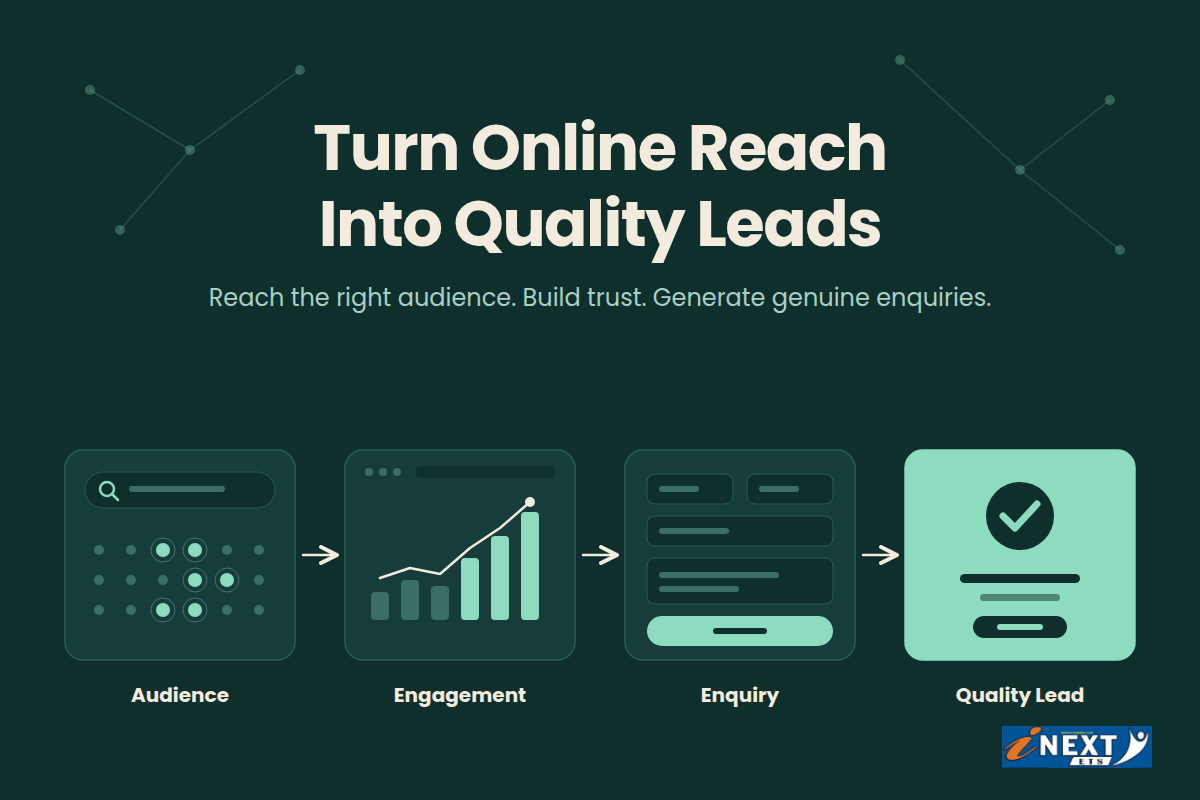
Right audience → Relevant message → Useful experience → Enquiry → Qualification → Follow-up → Conversion
What Makes a Lead a Quality Lead?
A quality lead isn't simply someone who fills out a form.
A quality lead is generally a person or business that has a genuine need for what you offer and meets the criteria that matter to your business.
Those criteria can differ significantly between industries.
For one business, location might be critical. For another, budget or business size may matter more. A B2B company may look at company type and decision-making authority, while a local service business may care more about location and immediate need.
A useful quality-lead framework is:
| Question | What it helps determine |
|---|---|
| Do they need the service? | Relevance |
| Are they part of the target audience? | Audience fit |
| Are they searching or enquiring with genuine intent? | Buying intent |
| Can the business serve them? | Service fit |
| Are they realistically able to purchase? | Opportunity |
| Are they willing to take the next step? | Engagement |
This is why lead quality and lead quantity should be considered together.
Why Are Businesses Getting Leads That Don't Convert?
One of the most frustrating situations for a business is seeing enquiries increase without seeing a similar improvement in sales.
There can be several reasons.
1. The Target Audience Is Too Broad
Trying to reach everyone can result in reaching people who were never likely to become customers.
The first step is understanding:
Who needs your service?
Where are they located?
What problem are they trying to solve?
What questions do they ask?
What factors influence their decision?
The more clearly these questions are answered, the easier it becomes to create relevant campaigns.
2. The Marketing Doesn't Match Search Intent
Not every searcher has the same intention.
For example:
Informational:
What is SEO?
Problem-focused:
Why is my business website not generating leads?
Commercial investigation:
High-intent:
SEO company for small business
These searches may belong to the same broad topic, but the people behind them are at different stages.
A strong SEO and content strategy should therefore match the content to the intent, instead of trying to use one page for every possible search.
3. The Advertisement and Landing Page Don't Match
Imagine someone clicks an advertisement offering a free consultation but lands on a generic homepage.
The visitor now has to search for the promised offer.
That extra friction can affect conversions.
The landing page should continue the same message that brought the visitor there.
Ad/message → Landing page → Offer → CTA
The journey should feel consistent.
4. Enquiries Aren't Being Qualified
A form submission is not automatically a sales opportunity.
If a business doesn't have basic qualification criteria, its marketing reports may make the campaign appear more successful than it actually is.
5. Follow-Up Is Inconsistent
Even a relevant enquiry can be lost when there is no clear follow-up process.
Lead generation doesn't end when someone submits a form.
It continues through communication, qualification and the next appropriate sales step.
9 Ways to Generate Quality Leads Through Digital Marketing
1. Define Your Ideal Customer
Before deciding which platform to use, define who you actually want to attract.
Consider:
Industry
Location
Business size
Customer needs
Common problems
Buying stage
Budget range where relevant
Services/products they are looking for
For example, a digital marketing company targeting local businesses may need a very different strategy from one targeting large B2B organisations.
Better targeting starts with knowing who you're targeting.
2. Understand the Search Intent Behind Your Keywords
SEO shouldn't be treated as simply putting keywords into an article.
The real question is:
What does someone expect to find when they search this phrase?
Suppose your target keyword is related to lead generation.
Someone searching:
"what is lead generation?"
probably wants an explanation.
Someone searching:
"lead generation agency"
may be evaluating service providers.
Someone searching:
"lead generation services for small business"
has a more specific commercial requirement.
Creating content that matches these different intents can help attract more relevant visitors.
3. Use SEO to Attract Relevant Searchers
SEO can help businesses appear when potential customers search for problems, solutions, products or services.
But traffic alone isn't the objective.
A business might rank for thousands of searches and still generate few useful enquiries if those searches aren't relevant to its customers.
For lead generation, SEO should therefore consider:
Search intent
Relevant keywords
Topic coverage
Useful content
Service pages
Local search where applicable
Internal linking
Website experience
Conversion opportunities
The goal is to attract people who have a meaningful reason to visit the website.
4. Use Paid Search Strategically
Google Ads and other paid campaigns can help businesses reach people searching for particular products or services.
However, spending more doesn't automatically mean generating better leads.
Campaign performance can be influenced by:
Keyword selection
Search intent
Geographic targeting
Ad messaging
Audience targeting
Landing-page relevance
Budget
Conversion tracking
A campaign targeting a highly specific service-related search can attract a very different audience from one targeting a broad informational keyword.
The focus should be relevance and measurable outcomes, not simply clicks.
5. Use Social Media to Build the Right Audience
Social media can support lead generation by helping businesses:
Reach relevant audiences
Answer common questions
Demonstrate expertise
Build familiarity
Showcase products or services
Encourage enquiries
But follower count alone doesn't tell you whether social media is generating useful business opportunities.
A smaller, relevant audience can be more meaningful than a large audience with little connection to the business.
Content should therefore have a purpose.
That could be:
Educate → Build trust → Create interest → Encourage action
6. Create Useful Content Around Real Customer Problems
Content marketing becomes more useful when it starts with actual questions customers ask.
For example:
Why isn't my website generating leads?
How does SEO help businesses?
Should I use SEO or Google Ads?
How can a small business generate enquiries online?
Why are my advertising leads not converting?
These questions can become:
Blog articles
Guides
Videos
FAQs
Social media posts
Downloadable resources
A useful content strategy can attract people earlier in their decision-making journey and help them understand their options.
7. Build Conversion-Focused Landing Pages
Driving traffic to a website is only part of the process.
The visitor also needs a clear next step.
A landing page may include:
Clear headline
Explain what the visitor can get.
Relevant information
Address the problem or need.
Trust signals
Provide appropriate evidence that helps the visitor evaluate the business.
Clear CTA
Tell the visitor what to do next.
Simple enquiry process
Don't create unnecessary friction.
For example:
Relevant search → Relevant landing page → Clear offer → Simple enquiry → Follow-up
This is where website development and digital marketing need to work together.
8. Qualify Your Leads
Businesses should define what makes an enquiry worth pursuing.
Depending on the industry, qualification may consider:
Need
Location
Budget
Service requirement
Timeline
Business type
Decision-making role
Product fit
This is where terms such as MQL and SQL can be useful.
What Is an MQL?
A Marketing Qualified Lead (MQL) is a prospect who has shown enough relevant interest or engagement to be considered worth further marketing or sales attention, according to the business's criteria.
What Is an SQL?
A Sales Qualified Lead (SQL) is a prospect who has been assessed as appropriate for sales follow-up based on the organisation's qualification criteria.
The exact criteria should be defined by each business rather than assuming every enquiry belongs to one category.
9. Follow Up and Nurture Relevant Prospects
Not everyone is ready to buy immediately.
Some prospects may need:
More information
A consultation
A demonstration
Pricing details
Answers to questions
Additional time before making a decision
A suitable follow-up process can help businesses stay connected with relevant prospects.
The important point is that lead generation and lead management should work together.
The right approach can also vary depending on whether a business is trying to build visibility, generate enquiries, improve conversions or scale an existing digital presence. For a broader look at how these elements can work together, you can read: How I Next ETS Helps Businesses Build, Grow and Scale in the Digital World.
How Your Website Affects Lead Quality
Your website is often the point where marketing activity becomes an actual enquiry.
A business can invest in SEO, advertising and social media, but if the website doesn't communicate clearly, some of that traffic may never convert.
A lead-generation-focused website should make it easy for visitors to:
Understand what the business offers
Find relevant services
Understand the value of the offer
Build confidence
Contact the business
Take the intended next step
Important considerations include:
Mobile usability
Page speed
Clear navigation
Service-specific pages
Strong calls to action
Trust information
Simple forms
Relevant landing pages
This is one reason website development and digital marketing shouldn't always be treated as separate activities.
SEO vs Google Ads vs Social Media for Lead Generation
There is no single channel that is automatically suitable for every business.
| Channel | Typical role |
|---|---|
| SEO | Attract relevant organic searches |
| Google Ads | Reach people actively searching for solutions |
| Social media | Build awareness and audience engagement |
| Content marketing | Educate and build trust |
| Local SEO | Reach customers searching within a specific location |
| Landing pages | Convert relevant traffic into enquiries |
| Remarketing | Re-engage people who have previously interacted with the business |
The right mix depends on the audience, business model, goals, competition and available resources.
Local Businesses: Don't Ignore Local Search
For businesses serving a specific city or area, local search can be an important part of lead generation.
Depending on the business, this can include:
Google Business Profile optimisation
Relevant local keywords
Location-specific service pages
Customer reviews
Accurate business information
Useful local content
Clear contact options
For example, a business serving Bhopal may need to make it clear which services it provides in Bhopal rather than relying only on a generic national-level page.
However, local SEO should still be based on genuine relevance. Creating dozens of near-identical location pages without useful local information can result in poor user experiences.
How to Measure Lead Quality
A campaign shouldn't be judged only by the number of enquiries it generates.
Consider measuring:
Lead volume
How many enquiries were generated?
Qualified lead rate
What percentage met the business's qualification criteria?
Cost per lead
How much did each enquiry cost?
Cost per qualified lead
How much did it cost to generate a relevant prospect?
Conversion rate
How many leads eventually became customers?
Customer acquisition cost
How much did the business spend to acquire a customer?
Revenue
What business value resulted from the campaign?
This provides a more complete view of performance.
A Simple Lead-Quality Scorecard
Businesses can create their own qualification system.
For example:
| Qualification question | Example consideration |
|---|---|
| Does the prospect need the service? | High relevance |
| Is the prospect in the target market? | Audience fit |
| Does the requirement match the service? | Service fit |
| Is there genuine buying intent? | Intent |
| Is the timing appropriate? | Sales readiness |
| Can the business realistically serve them? | Operational fit |
This doesn't need to become complicated.
The purpose is simply to distinguish an enquiry from a genuinely relevant opportunity.
A Realistic Example: More Leads vs Better Leads
Consider an imaginary business running two campaigns.
Campaign A
100 enquiries
→ 60 irrelevant
→ 25 weak prospects
→ 15 relevant prospects
Campaign B
40 enquiries
→ 15 irrelevant
→ 25 relevant prospects
Campaign A generated more total enquiries.
But Campaign B generated more relevant prospects in this simplified example.
This illustrates why businesses should avoid evaluating marketing solely on lead volume.
The actual value of a campaign depends on factors such as qualification, conversion, cost and revenue.
Common Mistakes That Reduce Lead Quality
Chasing traffic instead of relevance
More visitors don't automatically mean more customers.
Targeting keywords without understanding intent
High search volume isn't enough if the audience isn't relevant.
Sending every visitor to the homepage
Different campaigns may need different landing pages.
Making the CTA unclear
Visitors should understand the next step.
Ignoring mobile experience
A website or form that is difficult to use on mobile can create unnecessary friction.
Measuring only cost per lead
A cheap lead isn't necessarily a valuable lead.
Ignoring follow-up
Relevant enquiries can be lost if they aren't handled properly.
Treating every enquiry as equally valuable
Qualification helps businesses understand which opportunities deserve further attention.
A Practical Digital Marketing Lead Generation Workflow
A simple process can look like this:
1. Research
Understand the audience, market, competitors and customer problems.
2. Define
Decide who the business wants to attract and what qualifies as a good lead.
3. Target
Choose relevant keywords, audiences and channels.
4. Attract
Use SEO, paid advertising, social media and useful content.
5. Convert
Use relevant landing pages, CTAs and enquiry forms.
6. Qualify
Determine whether the enquiry matches the business's criteria.
7. Follow up
Communicate with relevant prospects and move them toward the appropriate next step.
8. Measure
Track qualified leads, conversions, costs and business outcomes.
9. Improve
Use the data to refine targeting, content, campaigns and conversion points.
This turns quality leads through digital marketing from a one-time campaign objective into an ongoing process.
Questions Businesses Should Ask Before Starting a Lead Generation Campaign
Before investing in a campaign, ask:
Who exactly are we trying to reach?
What problem are we solving?
What makes someone a qualified lead?
Which searches show genuine intent?
Does our website support conversion?
Is our offer clear?
Is our CTA easy to understand?
How will enquiries be qualified?
Who will follow up?
Which metrics will we track?
How will we know whether the campaign generated actual business value?
Answering these questions beforehand can make the marketing strategy much more focused.
Quality Lead Generation Checklist
Before launching a campaign, check:
☐ Target audience is clearly defined
☐ Search intent has been researched
☐ Relevant keywords have been selected
☐ Offer is clearly explained
☐ Landing page matches the campaign
☐ CTA is easy to understand
☐ Website works well on mobile
☐ Enquiry process is simple
☐ Lead qualification criteria are defined
☐ Follow-up process is ready
☐ Qualified leads are being tracked
☐ Conversions are being measured
☐ Campaign performance will be reviewed regularly
How I Next ETS Can Support Your Lead Generation Strategy
Effective digital lead generation often involves several connected parts of online marketing.
I Next ETS works across SEO, digital marketing, website development, social media marketing and lead generation, allowing businesses to build a strategy around their audience, services and business objectives.
The appropriate combination of services depends on factors such as the industry, target audience, location, competition, website and current marketing activity.
Rather than focusing only on generating more enquiries, businesses can first identify where the current gap exists:
Visibility → Traffic → Conversion → Qualification → Follow-up → Customer
That creates a more practical starting point for improving lead generation.
Final Thoughts
Generating more leads can look like progress, but the real question is what happens after those leads arrive.
Are they relevant?
Do they need the service?
Are they in the right market?
Are they ready to have a conversation?
And does the business have a process for helping those prospects take the next step?
That is why quality leads through digital marketing should be approached as a complete system rather than a single advertising campaign.
Right audience → Relevant message → Right channel → Useful experience → Enquiry → Qualification → Follow-up → Conversion
When these parts work together, businesses have a clearer foundation for building a sustainable digital lead-generation strategy.