
How SEO Helps Generate Qualified Leads for Your Business: 10 Strategies That Work
Practical guidance on attracting the right visitors, matching their search intent and making it easy for them to get in touch.
Getting people to visit your website is one thing. Getting the right people to contact your business is another. Many businesses invest in their online presence but still struggle to generate enquiries, because the traffic they receive doesn’t always come from people who need their services. This is where qualified leads through SEO can make a real difference. SEO helps your business appear when potential customers search for relevant services, brings the right audience to your website and makes it easier for interested prospects to get in touch. Here’s how it works, and the strategies that help.
But there is an important difference between website traffic and business-generating traffic. A visitor searching for "what is SEO?" may simply be researching. Someone searching for "SEO company for my business" is much closer to making a buying decision.
This is where search engine optimisation (SEO) can make a difference. SEO helps businesses become more visible when potential customers search for relevant products, services or solutions. When done well, it can bring the right audience to a website, help visitors understand what a business offers and make it easier for interested prospects to get in touch.
Let's look at how SEO contributes to qualified lead generation and why it matters for businesses that want to grow online.
SEO Traffic vs Qualified Leads: What's the Difference?
Getting 10,000 website visitors may sound impressive, but traffic alone doesn't tell you whether those visitors can become customers. A qualified lead is a person or business that has shown interest in your services and is a realistic fit for what you offer, such as being in your service area and having a need you can meet.
Consider two illustrative examples:
| Website A | Website B | |
|---|---|---|
| Monthly visitors | 10,000, mostly informational | 2,000, highly relevant |
| Enquiries | 15 | 40 |
These figures are illustrative only. They are not industry benchmarks or results from any client.
The principle is what matters: SEO should be evaluated by relevance and business outcomes, not traffic volume alone.
1. SEO Helps You Reach People Who Are Already Looking for Your Services
Think about the way people search for a service before choosing a provider. Someone who needs a new business website might search for a website development company, compare different providers and then visit the websites that seem most relevant.
Your business has a better chance of being considered if it appears for searches related to the services you actually provide. That's one of the biggest advantages of SEO. Instead of relying entirely on advertising or waiting for referrals, your website can attract people who are actively looking for what you offer.
Of course, not everyone who searches will become a customer. Some visitors are only exploring their options, while others may not be the right fit for your business. The aim is to improve your visibility among people whose needs match your services.
This starts with understanding your audience, the problems they want to solve and the search terms they use to find solutions.
2. Why Search Intent Matters More Than Traffic Alone
A website can attract hundreds of visitors and still generate very few enquiries. One reason is that the content may be attracting people who aren't interested in becoming customers.
Consider a digital marketing company that wants to attract businesses looking for SEO services. Searches can broadly fall into three types of intent, and the people behind them are at different stages of their decision-making process.
| Search intent | What the searcher wants | Example searches |
|---|---|---|
| Informational | Answers and explanations | "What is SEO?", "How does SEO work?", "Benefits of SEO" |
| Commercial investigation | To compare providers or options | "Best SEO company", "SEO services for small businesses", "SEO agency for startups" |
| Transactional | To hire or enquire | "Hire SEO company", "SEO services near me", "SEO agency in Bhopal" |
Keywords should be mapped to the page that best satisfies the search intent, rather than forcing every keyword onto one page. Informational content can answer questions and introduce readers to a problem. Service pages can explain what the business offers, who it works with and how a prospective customer can enquire.
When each page serves a clear purpose, SEO can do more than bring visitors to the website. It can help connect people with the information they need to make their next decision.
3. Choosing the Right Keywords Can Bring Better Business Opportunities
Keywords influence which searches your website may appear for, but choosing them isn't simply about finding phrases with high search volumes. The more important question is whether a search is relevant to your business and whether the page you create can genuinely satisfy that search.
For example, a company offering website development may want to attract businesses looking for professional website development services. Targeting only broad terms such as "website" could bring visitors with very different needs.
A more focused keyword strategy considers the services offered, the audience being targeted and the reason someone would search for a particular phrase. It also considers competition. A keyword might sound ideal, but if established websites dominate the results, ranking for it could require considerable time and effort. Other relevant searches may offer a more realistic opportunity.
This is why keyword research should be connected to business goals. The objective is to identify searches worth targeting and create pages that give potential customers a useful reason to visit.
4. Helpful Content Gives Potential Customers a Reason to Trust You
Before contacting a company, people often want to understand whether it knows what it's doing. They may look for answers to their questions, explore its services or compare it with other providers. Your website content can help them make that decision.
Suppose a business owner is considering SEO services but isn't sure why their website receives visitors without generating enquiries. An article that explains the possible reasons can help them understand the problem and identify what they may need to review. It becomes more useful when it explains the issue clearly instead of repeating general advice or forcing keywords into every paragraph.
Useful content doesn't need to make exaggerated promises. In fact, clear explanations and realistic expectations can help establish greater trust than claims of guaranteed rankings or instant results. Over time, relevant content can help potential customers understand your expertise before they decide to contact you.
5. Build SEO-Focused Service Pages
Service pages are often where a searcher decides whether to get in touch. They should explain what the service involves, what business needs it addresses and what a prospective customer can expect from the process. Each service page should target a clear set of related searches, so it can satisfy the intent behind them rather than competing with other pages on your own website.
6. How SEO Turns Searchers Into Qualified Leads
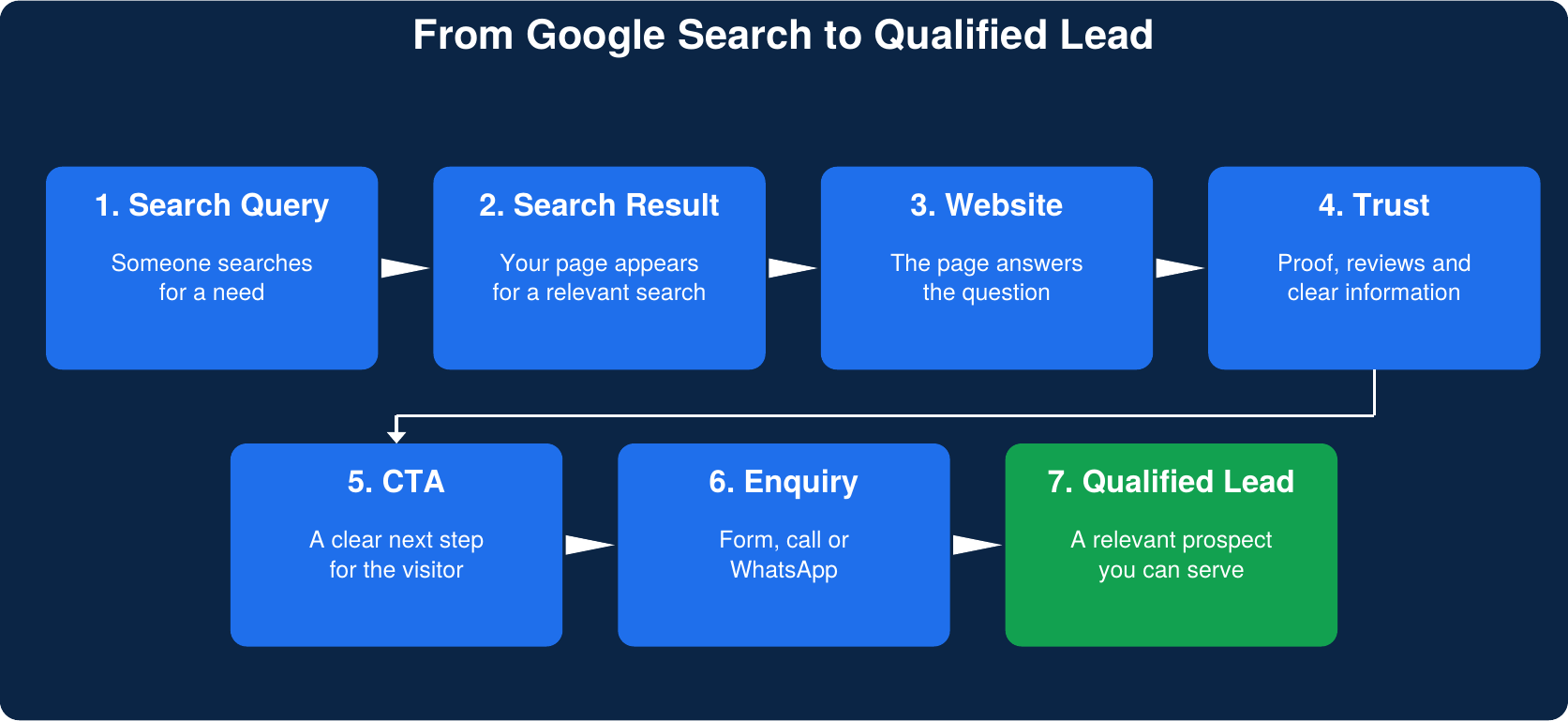
Qualified lead generation is a journey, not a single ranking. Each stage below needs to work for a search to become a sales opportunity.
| Stage | What happens |
|---|---|
| Google Search | A potential customer searches for a service or solution. |
| Relevant Search Result | Your page appears for a search that matches what you offer. |
| SEO Landing Page | The visitor arrives on a page built for that search. |
| Useful Information | The page explains the service clearly and answers common questions. |
| Trust / Proof | Reviews, case studies and other trust signals, where available, build confidence. |
| Clear CTA | The visitor sees an obvious, page-appropriate next step. |
| Enquiry | They submit a form, call or message the business. |
| Qualified Lead | The enquiry comes from someone the business can realistically serve. |
| Sales Follow-up | The business responds promptly and continues the conversation. |
7. Make Your Website Easy to Convert
Imagine someone finds your website through Google, reads your service page and decides that your business might be a good fit. But the page doesn't clearly explain how to contact you, the enquiry form is difficult to use, or the website is frustrating to navigate on a phone. That potential lead may leave without getting in touch.
This is why rankings and traffic are only part of the picture. Your website also needs to make it easy for interested visitors to take action.
"SEO can bring a potential customer to the page, but the page needs to help that visitor make a decision."
What Should a Lead-Generating SEO Page Include?
| Page element | Why it helps |
|---|---|
| Clear service explanation | Visitors immediately understand what you offer |
| Strong, specific headline | Confirms the page matches the search |
| Benefits and relevant outcomes | Shows what the service can do for the customer |
| Relevant FAQs | Answers common questions before they become barriers |
| Reviews / testimonials, where available | Provide real customer feedback |
| Case studies, where available | Show how you have approached similar needs |
| Trust signals | Help visitors feel confident contacting you |
| Clear contact information | Removes guesswork about how to reach you |
| WhatsApp / call option, where appropriate | Gives visitors a quick, familiar way to get in touch |
| Simple enquiry form | Reduces effort and drop-off |
| Strong page-specific CTA | Fits the visitor's stage, such as "request a consultation" on a service page |
| Mobile-friendly experience | Works well for visitors on phones |
Your calls to action should fit the page. Someone reading about a specific service may be ready to enquire, while someone who has just discovered your business may need more information first. These improvements cannot guarantee more conversions, but they can reduce unnecessary obstacles between a visitor's interest and their decision to contact you.
8. Use Local SEO to Reach Relevant Customers in Your Area
For businesses that serve a particular city or region, local SEO can help them appear when nearby customers search for relevant services. For example, a business looking for digital marketing services in Bhopal may prefer a provider that understands its local market or offers support in the area. Examples like this are only appropriate where the business genuinely serves that market.
A business serving a defined area can improve its chances of being discovered by:
- Keeping business information accurate and maintaining an eligible Google Business Profile
- Developing service-area pages and location-specific service pages where relevant
- Keeping business information consistent across relevant directories
- Earning genuine customer reviews
- Publishing locally relevant content and giving clear information about the areas served
However, adding a city name repeatedly throughout a website isn't enough. Local content should read naturally, be relevant to the area and accurately reflect the services the business provides. Local SEO is particularly useful when a business wants to attract enquiries from a defined service area rather than visitors from locations it cannot serve.
9. Why SEO and Content Marketing Work Together
"SEO helps identify what your audience is searching for. Content gives your website an opportunity to answer those searches."
Different content formats can support different stages of the customer journey [see our Business Growth Package]
- Educational blog posts
- Service guides
- FAQs
- Comparison articles
- Case studies
- Industry insights
- Local guides
- Expert-led content
10. Measure SEO by Business Outcomes
SEO performance is often discussed in terms of rankings, impressions and website traffic. These metrics are useful, but they don't tell the whole story. For a business focused on generating leads, it's equally important to understand what visitors do after arriving on the website. Are they visiting relevant service pages? Are they submitting enquiry forms or calling the business? Are those enquiries coming from people the business can actually serve?
| Metric | What it tells you |
|---|---|
| Impressions | Search visibility |
| Clicks | Search interest |
| Organic traffic | Website visits |
| Engaged visits | Content relevance |
| CTA clicks | Buying interest |
| Enquiries | Lead generation |
| Qualified leads | Business opportunity |
| Customers | Revenue outcome |
Google Search Console can help identify which searches bring people to your website and which pages receive search traffic. Website analytics and properly configured conversion tracking can help measure actions such as form submissions and contact clicks.
The most important metric depends on the business model. Local service businesses may focus on calls and enquiries, while e-commerce businesses may focus on transactions and revenue. It's also worth reviewing the quality of enquiries: ten enquiries with little connection to your services may be less valuable than a smaller number of relevant prospects who are genuinely interested in working with you.
SEO results take time, and performance can vary depending on competition, website condition and the work being carried out. Regular measurement helps businesses understand what's improving, where opportunities remain and which pages need attention. The real value comes from connecting search performance with the outcomes the business wants to achieve.
SEO Is Only One Part of the Lead-Generation System
SEO can help people discover your business, but qualified lead generation also depends on what happens after the click. Website speed, messaging, service pages, trust signals, reviews, calls to action, enquiry forms and sales follow-up can all influence the outcome.
SEO isn't a quick fix for every lead generation problem. It takes time to build search visibility, and appearing in search results doesn't automatically mean people will become customers. But when your website targets relevant searches, provides useful information and makes it easy for visitors to enquire, SEO can become a valuable part of your long-term digital marketing strategy.
How I NEXT ETS Approaches SEO for Lead Generation
SEO works best when keyword targeting, content, service pages, website usability and performance measurement support the same goal. Our approach follows ten steps:
| Step | Focus |
|---|---|
| 1 | Understand the business, services, customers and market |
| 2 | Analyse existing search visibility, pages, queries and competitors |
| 3 | Research search intent and identify relevant opportunities |
| 4 | Map keywords to the right pages |
| 5 | Improve technical SEO and mobile experience |
| 6 | Optimise service and landing pages |
| 7 | Build topical authority through useful content |
| 8 | Strengthen local SEO where relevant |
| 9 | Improve conversion paths: forms, calls, WhatsApp and CTAs |
| 10 | Measure traffic, enquiries, qualified leads and business outcomes |
If your website is receiving visitors but generating fewer enquiries than expected, the problem may not simply be traffic. Your keywords, search intent, landing pages, website experience and conversion journey all need to work together.
I NEXT ETS helps businesses build SEO strategies focused on visibility, relevant traffic and measurable enquiries.
Get in touch with I NEXT ETS for a digital growth consultation.
Explore our SEO Services or Digital Marketing Services, or visit www.inextets.com
SEO• Digital Marketing • Website Development • Lead Generation