
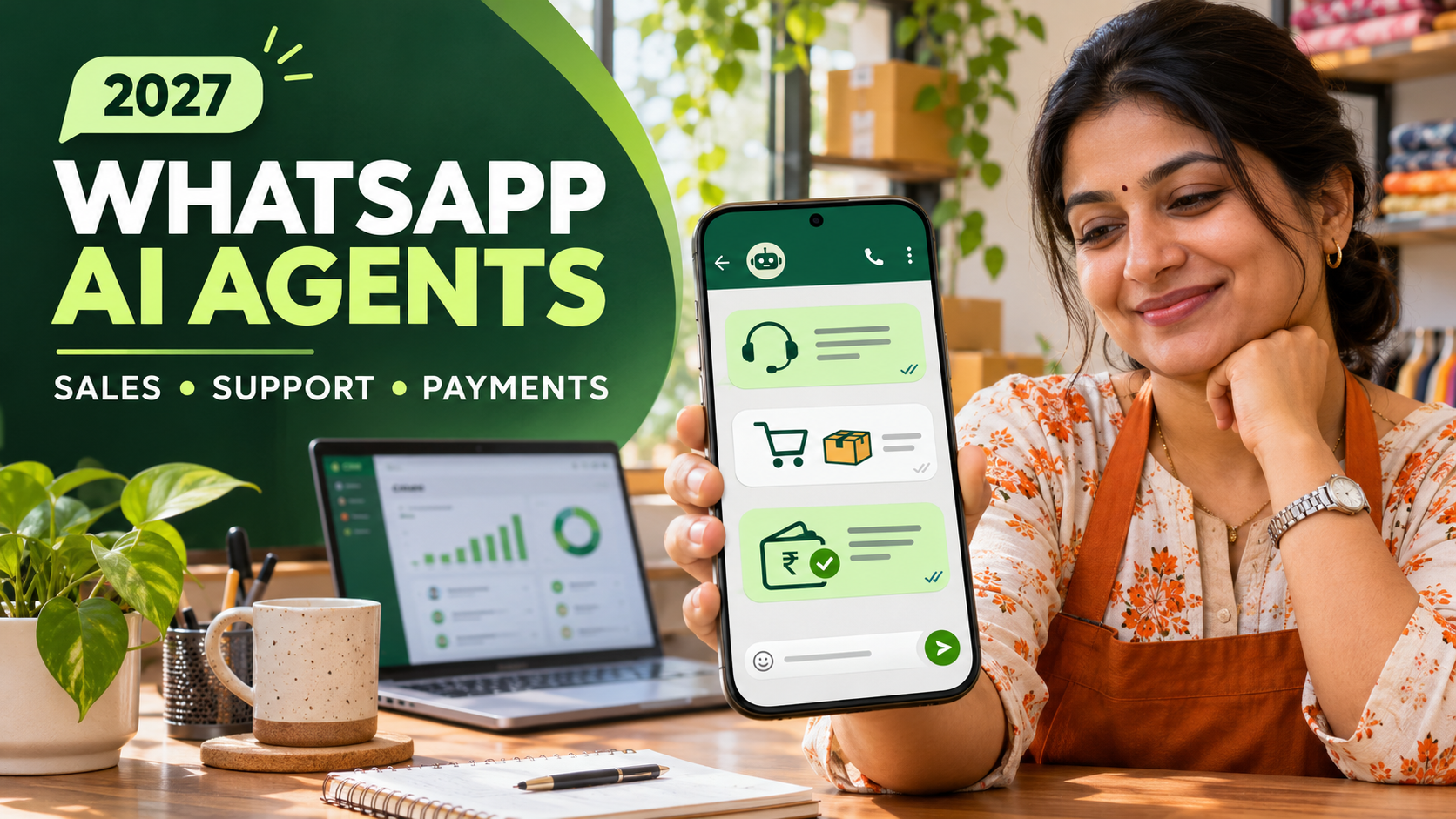
AI Agents on WhatsApp in 2027: How Businesses Can Automate Sales, Support & Payments
Imagine a customer messaging your business on WhatsApp at 11:30 PM.
They want to know whether a product is available, how much it costs and whether they can place an order immediately.
Normally, the customer might have to wait until your team returns the next morning.
But what if an AI-powered assistant could answer their questions, recommend a suitable product and help them proceed towards payment—even when your team is offline?
This is the opportunity presented by WhatsApp AI agents.
WhatsApp has already become an important communication channel for businesses in India. Customers use it to ask questions, discuss products, request quotations, schedule appointments and communicate with service providers.
Now, artificial intelligence is introducing more advanced ways to manage these conversations.
In May 2026, Meta announced Business AI for eligible small businesses using WhatsApp in India. The capability allows businesses to automate customer responses, share product information and assist with routine enquiries.
On November 17, 2026, Razorpay announced its integration with Meta Business Agent, enabling eligible businesses to offer Razorpay-powered payment links within AI-assisted WhatsApp conversations.
These developments point towards a growing business model known as conversational commerce, where customer communication, product discovery and purchasing become part of a connected experience.
As businesses prepare for 2027, understanding WhatsApp AI agents can help them evaluate new opportunities for customer engagement, lead generation and operational efficiency.
In this guide, we'll explain what WhatsApp AI agents are, how they work, their business applications, setup options, costs, limitations and considerations before implementation.
What Is a WhatsApp AI Agent?
A WhatsApp AI agent is an artificial intelligence-powered system that can interact with customers through WhatsApp, understand their questions and provide relevant responses based on the business's information and configured capabilities.
Unlike a basic chatbot that follows only predefined rules, an AI agent can use natural-language processing to interpret different ways of asking the same question.
Depending on its configuration and available integrations, a WhatsApp AI agent may help with:
Answering frequently asked questions
Sharing product or service information
Recommending relevant products
Collecting customer requirements
Qualifying potential leads
Scheduling appointments
Providing order updates
Routing conversations to human staff
Connecting customers to supported payment workflows
Not every WhatsApp AI agent supports all these functions automatically.
For example, an agent may be able to answer questions about your services without being authorized or technically equipped to update your CRM, modify orders or initiate payments.
Those additional capabilities depend on the chosen platform, permissions and integrations.
Example: AI Agent for a Website Development Company
Suppose a customer messages a digital agency:
Customer: "Hi, I need an e-commerce website. What will it cost?"
AI Agent: "I'd be happy to help. Are you looking for a basic online store or a custom e-commerce platform with advanced features?"
Customer: "I need around 100 products and online payment."
AI Agent: "Thanks. Would you like to share your preferred timeline and budget range so the team can prepare a more relevant consultation?"
Customer: "My budget is around ₹2 lakh."
AI Agent: "Thank you. I can share your requirements with the team and help arrange a discussion."
This is an illustrative conversation, not an actual iNext ETS deployment.
The AI agent helps collect preliminary requirements, but a human professional can review the details before providing a formal quotation.
Why Are WhatsApp AI Agents Becoming Important in India?
WhatsApp is already widely used for business communication in India.
According to a 2025 Kantar study cited by Meta, 91% of surveyed online adults in India chat with businesses weekly.
For small businesses, this creates an opportunity to improve responsiveness through a communication channel customers already know.
1. Customers Expect Faster Responses
Potential buyers may contact several businesses before making a decision.
If one company responds quickly while another takes hours, the customer experience can be very different.
AI agents can help provide immediate answers to routine questions, reducing dependence on staff availability.
2. Businesses Receive Repetitive Enquiries
Many customer conversations involve similar questions:
What are your prices?
Is this product available?
Where is your office?
Do you provide delivery?
How can I book an appointment?
What services do you offer?
Automating suitable responses can allow employees to spend more time handling complex requirements.
3. Sales Conversations Are Becoming More Connected
Customers may discover products, compare options and ask questions without leaving a messaging platform.
AI assistants can help businesses organize these interactions.
The objective is to reduce unnecessary steps between the customer's initial enquiry and the next appropriate action.
4. AI Can Support Multiple Languages
India's businesses communicate with customers across different languages and regions.
Meta has announced support for Indian languages in its Business AI experience.
For eligible businesses, this may help make routine customer communication more accessible.
However, multilingual AI responses should still be tested for accuracy, especially when handling technical, financial or sensitive information.
How WhatsApp AI Agents Work
A typical WhatsApp AI automation system involves several components.
Step 1: A Customer Starts a Conversation
A customer messages your WhatsApp Business account.
They may arrive through:
A website WhatsApp button
A click-to-WhatsApp advertisement
A social media profile
A QR code
An existing business contact
Step 2: The AI Interprets the Message
The system identifies the customer's question or likely intent.
For example:
"Do you offer website development?"
The AI recognizes that the user is enquiring about a specific service.
Step 3: The Agent Uses Business Information
The AI may use approved business information, such as:
Service descriptions
Product catalogues
Pricing information
Frequently asked questions
Business hours
Company policies
More advanced systems may retrieve information from connected software or databases.
Step 4: The Agent Responds or Takes an Authorized Action
The agent provides an answer or guides the customer towards the next step.
For example, it may:
Explain service options
Ask a relevant follow-up question
Provide booking information
Collect an enquiry
Transfer the conversation to a team member
Step 5: The Business Reviews the Outcome
A well-configured implementation should allow businesses to monitor conversations, review automation performance and handle situations requiring human judgement.
For example, a complex development quotation should be reviewed by an appropriate employee rather than automatically finalized using incomplete information.
7 Ways Businesses Can Use WhatsApp AI Agents in 2027
1. Automate Customer Support
Customer support is one of the most practical applications of WhatsApp AI agents.
An AI assistant can answer common questions about products, services, business hours, return policies and appointments.
For example, an e-commerce company might use an AI assistant to respond to questions about shipping options or product availability.
If an enquiry requires a refund decision or involves an unusual complaint, the conversation can be transferred to a human representative.
Business benefit: Faster responses to routine questions and more time for staff to handle complex issues.
2. Capture and Qualify Leads
For many service-based companies, WhatsApp conversations are potential sales opportunities.
AI agents can help collect useful information before a sales representative becomes involved.
For example, a digital marketing agency might ask:
What type of business do you operate?
Which service are you interested in?
What is your main marketing objective?
What is your approximate budget?
When would you like to begin?
This information can help the sales team understand the customer's requirements.
If properly integrated with a CRM, suitable enquiry details can be recorded for follow-up.
However, businesses should collect only necessary personal information and explain how it will be used.
Explore how a structured lead generation strategy can support the customer acquisition process.
3. Assist Customers With Product Discovery
AI agents can help customers identify relevant products based on their needs.
Suppose a customer messages a skincare business:
"I need a face wash suitable for oily skin."
An appropriately configured assistant could explain the available products and relevant product information.
It should avoid making unsupported medical claims or recommending unsuitable products.
For retail businesses, useful product discovery may include:
Product categories
Available sizes
Prices
Stock information
Product features
Delivery options
The accuracy of recommendations depends on the quality and freshness of the underlying business information.
4. Support Appointment Booking
Businesses that depend on appointments can use WhatsApp automation to streamline enquiry handling.
Potential use cases include:
Salon appointments
Business consultations
Property visits
Service demonstrations
Educational counselling
General service bookings
An AI assistant might collect a customer's preferred date, service and contact details.
If connected to a booking system, it may be able to check availability and complete a reservation.
Without such integration, it should clearly state that the request is pending confirmation.
5. Help Customers Complete Payments
Payment assistance is one of the most important recent developments in AI-powered business messaging.
On November 17, 2026, Razorpay announced that eligible Indian businesses could use its payment integration with Meta Business Agent.
The experience allows customers to ask questions, consider products and access a Razorpay-powered payment link during a WhatsApp conversation.
Supported payment methods include UPI, cards and net banking.
For example, a customer purchasing a gift hamper could:
Enquire about available hampers.
Ask for a recommendation.
Select an appropriate product.
Receive a payment link.
Complete payment through the supported flow.
This can make the purchasing process more convenient.
Important: Availability depends on business eligibility and the specific integration. Businesses should not assume every WhatsApp chatbot automatically supports payments.
Payment systems should use authorized providers and appropriate transaction confirmation mechanisms.
6. Automate Order and Service Updates
For businesses with connected order-management systems, WhatsApp automation may help customers receive relevant updates.
Examples include:
Order confirmation
Dispatch notifications
Delivery information
Appointment reminders
Service status updates
Payment confirmation
Such workflows require correct integrations, approved message templates where applicable and compliance with WhatsApp messaging rules.
A customer-facing AI system should never invent an order status when reliable information is unavailable.
7. Improve After-Sales Communication
Customer communication continues after a purchase.
Businesses may need to provide support, collect feedback or assist with product usage.
AI agents can support routine after-sales questions while referring complicated issues to the appropriate team.
For example, a software company might use a WhatsApp assistant to share product documentation or explain standard onboarding steps.
Customer complaints, sensitive account issues and contractual disputes should have clear human escalation procedures.
WhatsApp AI Agent vs Traditional WhatsApp Chatbot
Although these terms are often used interchangeably, they can describe different levels of automation.
Traditional Rule-Based Chatbot
A rule-based chatbot responds according to predefined menus, keywords and conditions.
For example:
"Press 1 for pricing."
"Press 2 for customer support."
"Press 3 to speak with our team."
This approach can work well for predictable workflows.
AI-Powered Chatbot
An AI chatbot can interpret natural-language questions and generate responses using relevant business information.
For example:
A customer might ask, "Can I book an appointment tomorrow afternoon?"
The chatbot can understand the request even if it doesn't match a predefined keyword exactly.
AI Agent
An AI agent can combine conversational capabilities with authorized tools or workflows.
Depending on its implementation, it might retrieve information, collect customer details, check connected systems or initiate approved business processes.
However, the word "agent" does not guarantee that a product can perform independent actions.
Businesses should evaluate the actual features rather than relying on marketing terminology.
WhatsApp Business AI vs Custom WhatsApp AI Automation
Businesses considering WhatsApp AI automation generally have two broad paths.
Option 1: Meta's Business AI Features
Meta introduced Business AI for eligible small businesses in India in May 2026.
These features are designed to help businesses handle routine questions and provide product information from within the WhatsApp Business environment.
Potential advantages include:
A setup experience within WhatsApp Business
No requirement to develop a custom AI system for supported features
Automated responses to customer enquiries
Product information assistance
Human takeover options
Availability depends on Meta's eligibility requirements and product rollout.
Option 2: Custom WhatsApp Business Platform Integration
Some companies need more advanced functionality than an in-app assistant provides.
A custom WhatsApp Business Platform solution may connect messaging with:
CRM software
Booking systems
E-commerce platforms
Inventory databases
Customer service tools
AI models
Internal business software
For example, a company might require a WhatsApp AI agent to check a customer's booking status directly from its own software.
This may require custom integration and careful access controls.
Businesses exploring more advanced automation can review AI and machine learning solutions to discuss their requirements.
How Much Does a WhatsApp AI Agent Cost in India?
The cost of a WhatsApp AI agent depends on its capabilities and how it is implemented.
There is no universal fixed price.
Businesses should distinguish between several potential expenses.
1. Software or Platform Fees
A third-party automation platform may charge a monthly subscription.
Pricing can depend on:
Number of team members
Automation features
Conversation limits
CRM integrations
AI usage
Reporting capabilities
Meta's eligible in-app Business AI features and third-party software products have different pricing and availability arrangements.
2. WhatsApp Messaging Charges
Businesses using the WhatsApp Business Platform may incur messaging charges based on Meta's current pricing rules and message categories.
These charges can change.
Before preparing a budget, check the latest official WhatsApp Business Platform pricing for India.
3. AI Model Usage
Custom solutions using external AI models may incur usage-based costs.
Expenses depend on the model, message volume, response length and supporting tools.
4. Development and Integration
A custom solution may require engineering work for:
API configuration
AI knowledge-base setup
CRM integration
Business workflow automation
Testing
Security
Deployment
5. Maintenance
AI systems require ongoing monitoring.
Product information, business rules and integrations may change.
Businesses should budget for reviewing responses, updating information, handling errors and maintaining compatibility.
Expert recommendation: Request a detailed cost breakdown covering setup, subscriptions, message charges, AI usage, integrations and support before choosing a solution.
Which Businesses Can Benefit From WhatsApp AI Automation?
WhatsApp AI agents can be useful across industries, although the appropriate implementation depends on business needs.
E-commerce Businesses
Potential applications:
Product enquiries
Product recommendations
Order information
Purchase assistance
Customer support
Real Estate Companies
Potential applications:
Property enquiry qualification
Budget collection
Location preferences
Site-visit requests
Follow-up coordination
Educational Institutions
Potential applications:
Course information
Admission enquiries
Fee-related FAQs
Counselling appointments
General student support
Service-Based Businesses
Potential applications:
Service enquiries
Appointment requests
Quotation requests
Lead qualification
Customer communication
Digital Marketing Agencies
Potential applications:
Client enquiry handling
Initial requirement collection
Consultation scheduling
Service information
CRM-assisted follow-up
The most suitable starting point is usually a repetitive workflow with clear rules and measurable business value.
How to Set Up a WhatsApp AI Agent for Your Business
A successful implementation begins with planning.
Step 1: Define Your Business Objective
Decide what you want to automate.
For example:
Reduce response delays
Answer common support questions
Capture more enquiries
Qualify potential customers
Help customers discover products
Support appointment booking
Avoid trying to automate every process immediately.
Step 2: Choose the Right WhatsApp Solution
Evaluate whether your requirements can be met through eligible WhatsApp Business AI features or require the WhatsApp Business Platform.
For more complex systems, compare available providers and integration capabilities.
Step 3: Prepare Accurate Business Information
Create a reliable information source containing relevant details.
These may include:
Product and service descriptions
Pricing information
Business hours
Frequently asked questions
Terms and policies
Contact details
Escalation procedures
Review information regularly.
Step 4: Define the Agent's Responsibilities
Specify which tasks the agent may perform.
For example:
The agent may explain available services and collect enquiry details.
However, it may not confirm discounts, approve refunds or issue binding quotations without authorization.
These boundaries help reduce operational risk.
Step 5: Configure Human Handover
Customers should be able to reach a real person when necessary.
Define escalation rules for:
Complex complaints
Sensitive information
Unusual payment problems
Uncertain answers
High-value enquiries
Requests for human assistance
Step 6: Test Real Customer Scenarios
Before launch, test conversations that reflect your customers' actual questions.
Include incomplete information, unusual wording, multilingual questions and situations where the agent must admit uncertainty.
Step 7: Monitor Performance
After launch, evaluate how effectively the system supports your business goals.
Useful measurements may include:
Average initial response time
Successfully resolved routine enquiries
Human handover frequency
Qualified leads captured
Appointment completion rate
Customer satisfaction
Confirmed purchases
Automation cost per eligible interaction
Focus on real business outcomes rather than the total number of automated messages.
Important Risks and Limitations of WhatsApp AI Agents
AI automation offers opportunities, but it also requires responsible implementation.
AI Responses Can Be Incorrect
Generative AI can misunderstand questions or produce inaccurate information.
Use verified business information, testing and monitoring to reduce these risks.
Not Every Business Has Access to Every Feature
Meta Business AI and payment-related integrations may be restricted by eligibility, location or rollout stage.
Check current availability before promising specific capabilities.
Customer Data Requires Protection
AI systems may handle names, phone numbers, enquiry details and transaction-related information.
Businesses must manage access appropriately and follow applicable privacy requirements.
Automation Needs Human Oversight
AI should not independently make sensitive business decisions unless appropriate controls, authorization and safeguards exist.
Customers Need Clear Communication
Where appropriate, tell customers that they are interacting with an automated assistant.
Make it easy for them to request human support.
The Future of WhatsApp AI Agents in 2027
As AI-powered business messaging develops, WhatsApp may become a more connected channel for customer discovery, sales and support.
Several trends are worth monitoring.
Conversational Commerce
Customer enquiries, product discovery and payment assistance may become more closely connected.
Multilingual AI Support
Businesses may gain additional opportunities to serve customers in different Indian languages.
CRM and Business Software Integration
More companies may connect AI messaging with internal systems to reduce repetitive administrative work.
Human-AI Collaboration
Employees may increasingly work alongside AI assistants that handle routine conversations while humans manage sensitive and complex situations.
Greater Focus on Measurable Results
Businesses will need to evaluate whether automation actually improves response times, customer satisfaction and qualified lead generation.
The long-term value of WhatsApp AI agents will depend on practical implementation, not simply adopting the latest technology.
Final Thoughts: Is Your Business Ready for WhatsApp AI Automation?
WhatsApp AI agents are becoming an important consideration for businesses that want to improve customer communication and automate repetitive tasks.
The introduction of Meta Business AI in India and the integration of payment capabilities through Razorpay demonstrate how business messaging is evolving.
However, successful implementation requires more than enabling an AI assistant.
Businesses need accurate information, clearly defined workflows, appropriate technical integrations, human oversight and reliable performance measurement.
Whether you're running an e-commerce store, service company, educational institution or growing startup, the right AI automation strategy should address a real operational problem.
The goal isn't to automate every customer conversation. It's to make customer communication more useful, responsive and efficient.
Want to Explore AI Automation for Your Business?
At I Next ETS, we help businesses strengthen their digital capabilities through AI solutions, custom software development, digital marketing and lead generation services.
Whether you're exploring intelligent customer support, AI-powered workflows or software integrations, our team can help you evaluate the right technical approach for your business.
Explore our services:
Ready to explore AI-powered business automation?
Contact I Next ETS to discuss your business requirements and possible automation solutions.
I Next ETS — Building Smarter Digital Solutions for Growing Businesses.