Google Ads AI Max in 202
Google Ads AI Max in 2027: How It Works & How to Get More Leads
Running Google Ads is becoming more sophisticated.
Businesses are no longer competing only on keywords, bids and ad copy. They're also competing on how effectively their campaigns interpret search intent, identify potential customers and convert advertising spend into measurable business results.
Google has been introducing more artificial intelligence into its advertising platform to support these processes.
One of its most important developments is Google Ads AI Max.
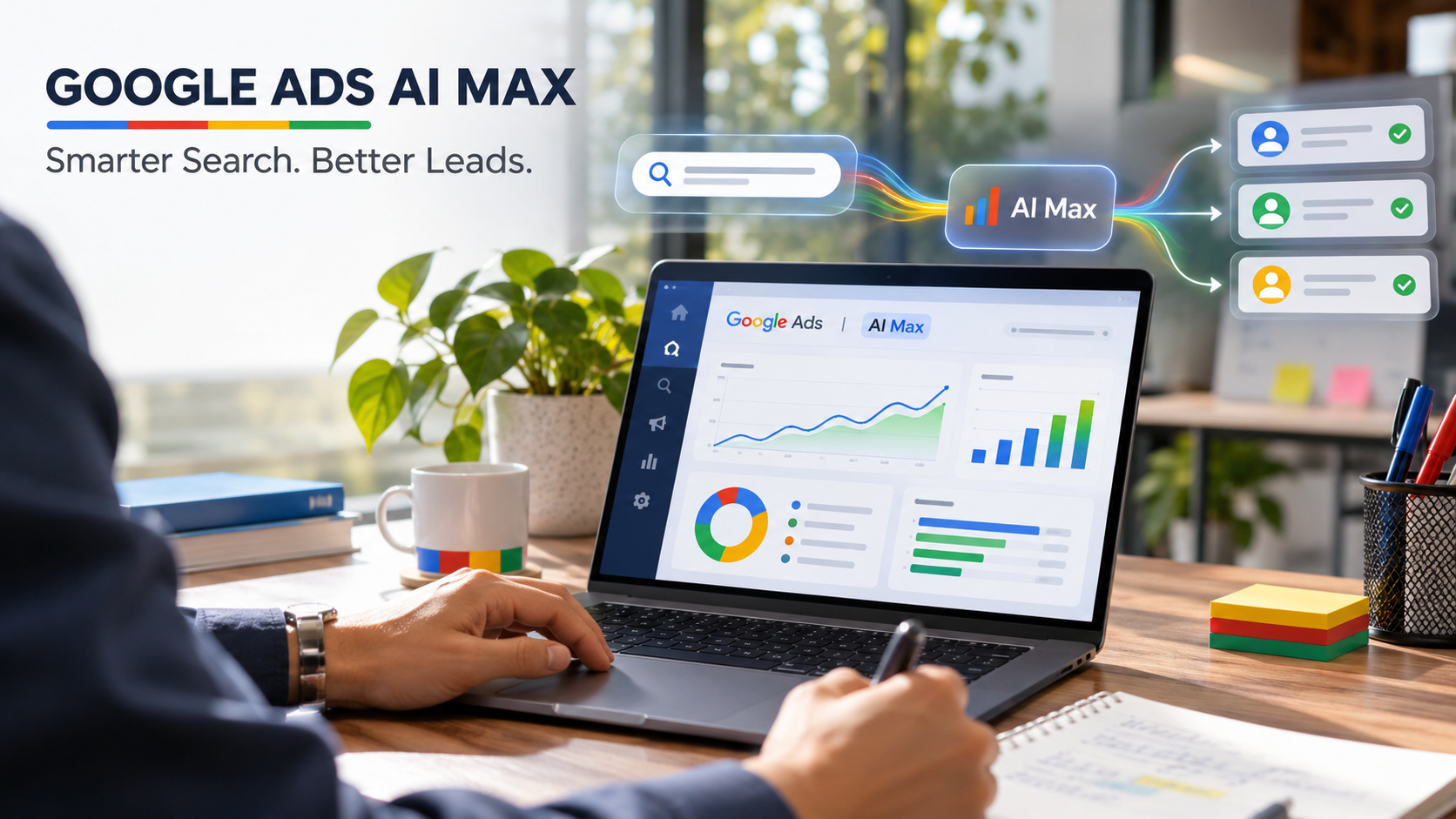
AI Max for Search campaigns uses Google's AI systems to expand relevant search-query coverage, customize ad messaging and help direct users to suitable landing pages.
For businesses investing in Google Ads lead generation, this creates new opportunities. It also introduces important questions about targeting, advertising budgets, brand control and lead quality.
Another major development is scheduled for 2027.
Google has announced that the transition of remaining eligible Dynamic Search Ads features to AI Max will begin in February 2027, following an earlier extension to the original timeline.
But what exactly is AI Max? Is it replacing Google Search Ads? How does it compare with Performance Max? And should businesses enable it to generate more leads?
In this guide, we'll explain how Google Ads AI Max works, its main features, benefits, limitations and practical optimization strategies for advertisers preparing for 2027.
What Is Google Ads AI Max?
Google Ads AI Max is a collection of AI-powered targeting and creative optimization features available within Google Search campaigns.
It helps advertisers identify additional relevant search opportunities and match their advertisements more closely to user intent.
AI Max is not a separate campaign type.
Instead, it works as an optimization layer within eligible Search campaigns.
It combines several capabilities:
Search term matching
AI-powered text customization
Final URL expansion
Additional brand and location controls
Search-term and asset reporting
Performance optimization using conversion signals
For example, imagine a business advertising custom website development services.
Its existing Google Search campaign targets the keyword:
"website development company"
A potential customer searches:
"Who can build an online store with payment integration for my clothing business?"
With AI Max search term matching, Google may identify this query as relevant based on the campaign's keywords, advertisements, landing pages and other available signals.
If the required features are enabled, Google may also adjust the advertisement's messaging or select a more relevant landing page.
The objective is to connect relevant searches with appropriate advertisements.
However, AI Max does not guarantee additional conversions or better return on advertising spend.
Campaign performance still depends on the offer, targeting, conversion tracking, website experience and advertising strategy.
Why Is Google Ads AI Max Important in 2027?
AI Max is becoming more relevant as Google expands AI-powered advertising capabilities.
One notable change involves Dynamic Search Ads.
Google originally announced a transition of legacy Dynamic Search Ads functionality to AI Max in 2026.
The company subsequently extended the timeline for the Dynamic Search Ads sunset and automatic upgrades, with that transition scheduled to begin in February 2027.
Some other legacy features, including Automatically Created Assets and campaign-level broad match settings, were scheduled for earlier upgrades in 2026.
This makes 2027 an important planning period for businesses using existing Search campaigns.
What Does This Mean for Advertisers?
Businesses should review their current Google Ads campaigns and understand how AI Max settings may affect their advertising.
Important considerations include:
Search-query expansion
Automated creative customization
Landing-page selection
Brand exclusions
Location targeting
Conversion tracking
Campaign reporting
Advertisers should check the notifications and settings in their own accounts because transition details may vary by campaign configuration and eligibility.
The change does not mean traditional keyword targeting or Search campaigns are disappearing.
It means Google is introducing a broader AI-powered optimization approach within its Search advertising system.
How Does Google Ads AI Max Work?
Google Ads AI Max combines targeting, ad creative and landing-page optimization.
Understanding its main components can help businesses make informed decisions.
1. Search Term Matching
Search term matching helps advertisers reach relevant searches beyond their existing keyword coverage.
Traditional Search campaigns use keywords and match types to determine which queries may trigger advertisements.
AI Max can expand this coverage using Google's AI systems, including broad match and keywordless approaches.
It considers signals from existing keywords, ad assets and website content.
Example
Suppose an agency targets:
"SEO services for businesses"
A potential customer searches:
"How can I improve my company's Google rankings and get more enquiries?"
AI Max may identify the broader query as relevant to the agency's services.
This could create an additional opportunity to reach a potential customer.
However, not every expanded query will be commercially valuable.
Advertisers should continue reviewing search-term relevance and lead quality.
2. AI-Powered Text Customization
Text customization allows Google to generate or adjust eligible ad messaging based on relevant business information and the user's search.
This may help create advertisements that better reflect specific queries.
For example, a website development company might advertise several services:
Business website development
E-commerce website development
Custom web applications
Different searches may benefit from different messaging.
AI-powered text customization can help provide more relevant combinations of headlines and descriptions.
However, businesses must ensure their websites contain accurate information.
Automatically generated messaging should not imply services, prices or guarantees the company cannot provide.
Advertisers should review available assets and account-level brand settings.
3. Final URL Expansion
Final URL expansion allows Google to select a different eligible landing page when it determines that another page on the advertiser's website may better match the user's query.
For example:
A business runs an advertisement promoting digital marketing services.
The original landing page covers digital marketing broadly.
A user searches specifically for Google Ads lead generation.
If final URL expansion is enabled, Google may select a more relevant page about lead generation instead.
This can help create a closer match between the search, advertisement and landing page.
However, it introduces an important consideration:
Not every page on a business website is suitable for paid advertising traffic.
An informational blog, outdated service page or unrelated page may not provide an appropriate conversion experience.
Advertisers should review URL expansion settings and use exclusions or other available controls where necessary.
4. Brand and Location Controls
AI-driven targeting does not mean advertisers must surrender all control.
AI Max includes additional options designed to help businesses manage targeting relevance.
These include brand-related controls and locations-of-interest functionality.
For example, a business offering services only in selected regions may need to ensure its campaign targets appropriate customer locations.
Advertisers should review both their standard campaign targeting settings and any additional AI Max controls.
5. Enhanced Reporting
As Google expands automation, reporting becomes increasingly important.
Advertisers need visibility into the searches that trigger their ads, the assets displayed and the landing pages selected.
Google announced additional reporting capabilities in September 2026 to make these relationships easier to examine.
Businesses should use the available reports to understand campaign performance and identify opportunities for improvement.
Google Ads AI Max vs Performance Max: What's the Difference?
AI Max and Performance Max both use Google's artificial intelligence, but they are not the same advertising solution.
Google Ads AI Max
AI Max works within Search campaigns.
Its main purpose is to enhance Search targeting, advertising messages and landing-page relevance.
It is particularly relevant to advertisers who want to improve the reach and efficiency of their existing Search campaigns.
Google Performance Max
Performance Max is a separate, goal-based campaign type.
It can serve advertisements across multiple Google advertising channels, including:
Search
YouTube
Display
Discover
Gmail
Maps
Performance Max uses campaign assets, audience signals, conversion goals and other information to optimize delivery across supported inventory.
Which Is Better for Lead Generation?
There is no universal answer.
A Search campaign using AI Max may be appropriate when a business wants to focus on people actively searching for relevant products or services.
Performance Max may be suitable when the business wants to use a broader mix of Google advertising inventory.
The right choice depends on:
Business objectives
Advertising budget
Conversion tracking quality
Available creative assets
Customer buying journey
Historical campaign performance
Expert recommendation: Evaluate AI Max for Search and Performance Max based on their actual contribution to qualified leads and customers, not simply reported impressions or clicks.
7 Benefits of Google Ads AI Max for Businesses
1. Discover Additional Relevant Search Opportunities
Customers don't always search using the exact keywords businesses expect.
AI Max can help identify relevant queries that aren't covered directly by an advertiser's keyword list.
This may expand campaign reach.
However, greater reach should not become the objective by itself.
The additional traffic must be relevant to the business.
2. Improve Advertisement Relevance
AI-powered text customization can help tailor advertisements to different search intents.
More relevant messaging may improve the experience between the user's query and the advertised service.
3. Match Visitors With Relevant Landing Pages
Final URL expansion can help direct users to pages that better address their specific requirements.
For example, someone searching for e-commerce development may be better served by an e-commerce service page than a general agency homepage.
4. Reduce Some Manual Optimization Work
AI Max can automate certain targeting and creative decisions.
This may allow advertisers to dedicate more attention to:
Campaign strategy
Offer development
Conversion tracking
Landing-page optimization
Lead qualification
Performance analysis
Automation still requires human oversight.
5. Support Lead Generation Campaigns
Businesses can use AI Max as part of a Search advertising strategy focused on generating enquiries.
Potential applications include:
Website development leads
Software development enquiries
Real estate consultations
Education enquiries
Professional service appointments
E-commerce customer acquisition
A well-designed lead generation strategy should connect relevant advertising traffic with suitable landing pages and follow-up processes.
6. Provide Additional Campaign Controls
Google offers options to help advertisers maintain brand and location relevance.
These controls are important when businesses have geographical restrictions, specific service areas or strict brand requirements.
7. Support Data-Driven Optimization
With appropriate conversion tracking and reporting, advertisers can examine whether expanded targeting and automated assets contribute to useful business outcomes.
However, these benefits are potential advantages, not guaranteed performance improvements.
How to Set Up Google Ads AI Max
AI Max can be configured within eligible Google Search campaigns.
The exact interface and available settings may change over time.
Step 1: Open Google Ads
Sign in to your Google Ads account.
Select an existing Search campaign or create a new eligible Search campaign.
Step 2: Review AI Max Settings
Find the AI Max settings within the campaign configuration.
Google's current documentation explains that AI Max can be enabled for new and existing Search campaigns.
Review the available options before activating them.
Step 3: Configure Search Term Matching
Check whether expanded search-term matching aligns with your campaign objectives.
Review your existing keywords, negative keywords and targeting settings.
For campaigns that depend on specific service categories, carefully monitor whether additional queries remain relevant.
Step 4: Review Text Customization
Ensure your website and advertising assets accurately describe your products or services.
Review the available creative controls.
Step 5: Configure Final URL Expansion
Decide whether Google should be allowed to select alternative landing pages.
If you enable this capability, review URL exclusions and other available restrictions.
For example, businesses may wish to exclude pages that are unsuitable for paid traffic.
Step 6: Verify Conversion Tracking
Before expanding automation, ensure the campaign measures meaningful conversions.
Examples include:
Completed quotation requests
Consultation bookings
Valid enquiry-form submissions
Purchases
Confirmed appointment requests
Step 7: Monitor and Optimize
After enabling AI Max, review campaign performance.
Pay attention to:
Search-term relevance
Conversion volume
Cost per lead
Qualified lead rate
Cost per qualified lead
Landing-page performance
Conversion value where applicable
Where appropriate, use Google's available experiment tools to compare performance against a suitable baseline.
8 Google Ads AI Max Optimization Strategies to Generate More Leads
Simply activating AI Max is not enough.
Businesses need an optimization strategy that connects advertising activity with commercial results.
1. Focus on High-Intent Search Campaigns
Start with services or products that have clear customer demand.
For example:
"Custom website development company"
may represent stronger commercial intent than:
"What is a website?"
Both searches can be useful, but they represent different stages of the customer journey.
AI Max may help expand coverage, but campaign structure and conversion objectives should remain aligned with business goals.
2. Use Accurate Conversion Tracking
One of the most important requirements for effective Google Ads automation is reliable conversion data.
If a campaign optimizes towards low-quality actions, it may generate more of those actions without improving actual business results.
For example, tracking every contact-button click as a confirmed lead can create misleading reporting.
Instead, measure completed enquiries whenever possible.
Businesses can configure meaningful conversion events using Google Ads, Google Analytics 4 and Google Tag Manager.
3. Optimize for Qualified Leads
Generating 100 enquiries is not necessarily better than generating 30.
The most important question is how many enquiries represent genuine potential customers.
Suppose:
Campaign A generates 100 enquiries, but only 10 are qualified.
Campaign B generates 40 enquiries, and 25 are qualified.
Campaign B may provide more commercial value despite generating fewer leads.
These are hypothetical numbers illustrating the importance of lead quality.
Businesses should connect advertising reports with CRM or sales information where practical.
4. Improve Landing-Page Quality
A relevant advertisement can bring visitors to your website.
However, the landing page determines whether those visitors understand your services and take action.
A high-converting landing page should include:
A clear headline
Relevant service information
A strong value proposition
Authentic trust signals
Mobile-friendly design
Simple enquiry forms
A prominent call to action
If your landing pages are outdated or confusing, consider reviewing your website development and optimization requirements.
5. Review Search Terms Regularly
Expanded reach can create additional opportunities, but it can also introduce irrelevant searches.
Advertisers should inspect the available search-term reporting and identify patterns.
For example, a company selling professional website development services may not want to prioritize users searching exclusively for free website-building tutorials.
Negative keywords and available targeting controls can help improve campaign relevance.
6. Control Landing-Page Expansion
Final URL expansion should be evaluated carefully.
Businesses should ensure that eligible landing pages are appropriate for the advertisements and intended customers.
For example, a digital marketing agency may have:
SEO service pages
Google Ads service pages
Website development pages
Blog articles
Career pages
A career page would generally not be a suitable destination for a customer-acquisition campaign.
Use available exclusion controls to help prevent unsuitable destinations.
7. Allocate Sufficient Budget for Meaningful Testing
Testing requires enough data to compare outcomes.
A campaign with limited traffic or very few conversions may take longer to provide useful evidence.
Google also warns that AI Max may be less effective when a campaign is constrained by its budget.
Avoid changing bids, budgets, targeting and creative settings repeatedly before understanding the results.
The appropriate testing period depends on conversion volume, business sales cycles and campaign performance.
8. Combine Automation With Human Expertise
AI can assist with targeting and creative optimization.
However, it does not automatically understand every commercial consideration.
Human oversight is still important for:
Budget allocation
Customer value
Profitability
Lead qualification
Brand positioning
Compliance
Campaign strategy
A professional digital marketing strategy should combine automation with business knowledge and performance analysis.
Common Google Ads AI Max Mistakes to Avoid
1. Enabling AI Max Without Tracking Real Conversions
Without reliable conversion tracking, advertisers may struggle to determine whether AI-driven changes generate useful business outcomes.
2. Ignoring Search-Term Relevance
Expanded matching should be monitored to understand whether the campaign is reaching appropriate customers.
3. Allowing Unsuitable Landing Pages
Businesses should review final URL expansion settings and prevent irrelevant pages from becoming advertising destinations.
4. Focusing Only on Clicks
More clicks do not necessarily mean more customers.
Qualified leads, customer acquisition costs and sales outcomes should remain important performance measures.
5. Making Too Many Campaign Changes at Once
Frequent changes can make performance comparisons difficult.
Use structured testing wherever possible.
6. Assuming AI Max Guarantees Better Results
AI Max is an optimization tool, not a guarantee of increased revenue.
7. Confusing AI Max With Performance Max
These are different advertising solutions with distinct campaign structures and distribution capabilities.
8. Ignoring Google's Transition Notifications
Businesses using legacy Dynamic Search Ads functionality should monitor account notifications and prepare for the announced 2027 transition.
Should Small Businesses Use Google Ads AI Max in 2027?
AI Max may be worth evaluating for small businesses that already use Google Search Ads.
However, suitability depends on several factors.
AI Max May Be Worth Testing If:
Your business has clear products or services.
You already generate relevant Search advertising traffic.
You have reliable conversion tracking.
Your landing pages provide accurate information.
You can monitor search-term and lead quality.
Your campaigns have sufficient budget and conversion data for meaningful evaluation.
Review Your Strategy First If:
Your business lacks conversion tracking.
Your website is outdated or difficult to use.
Your offer is unclear.
Your campaigns attract mostly irrelevant enquiries.
You have insufficient budget for meaningful testing.
Your sales team cannot identify qualified leads.
The priority should be building a reliable advertising foundation before expecting AI automation to improve performance.
The Future of Google Ads Automation in 2027
AI-powered advertising is likely to remain an important part of Google's advertising ecosystem.
Several developments are worth monitoring.
More AI-Assisted Targeting
Advertisers may increasingly rely on AI systems to identify relevant searches beyond manually selected keywords.
Dynamic Advertisement Creation
AI-assisted messaging may become more closely connected to search intent and landing-page content.
Greater Emphasis on Conversion Data
Accurate conversion measurement will remain important for helping automated systems optimize towards meaningful business outcomes.
More Connected Reporting
Advertisers need to understand how search queries, creative assets and landing pages work together.
Google has been expanding reporting capabilities to support this analysis.
Increased Importance of Human Strategy
As some technical optimization tasks become automated, business strategy, customer understanding, creative differentiation and accurate performance measurement may become even more valuable.
Final Thoughts: Prepare Your Google Ads Strategy for 2027
Google Ads AI Max represents an important development in AI-powered Search advertising.
Its combination of search term matching, text customization and final URL expansion offers advertisers additional ways to connect with relevant customers.
The announced transition of remaining eligible Dynamic Search Ads features beginning in February 2027 also makes it important for businesses to understand the system.
However, advertising automation cannot replace a clear business strategy.
Businesses still need accurate conversion tracking, relevant landing pages, compelling offers and consistent performance monitoring.
For companies seeking more qualified leads, AI Max should be evaluated as part of a broader digital marketing strategy—not treated as a one-click solution to every advertising challenge.
The goal of Google Ads is not simply to generate more clicks. It's to attract the right people and convert advertising investment into meaningful business opportunities.
Want to Improve Your Google Ads Lead Generation?
At I Next ETS, we help businesses strengthen their digital presence through Google Ads, performance marketing, lead generation, website development and digital marketing solutions.
Whether you're launching your first Search campaign, improving existing advertising performance or exploring AI-powered campaign features, our team can help you assess your requirements.
Explore our services:
Ready to improve your digital advertising strategy?
Contact I Next ETS to discuss your advertising goals and campaign requirements.
I Next ETS — Smarter Digital Strategies for Business Growth.