Google Maps SEO in 2027: How to Rank Higher and Get More Local Leads
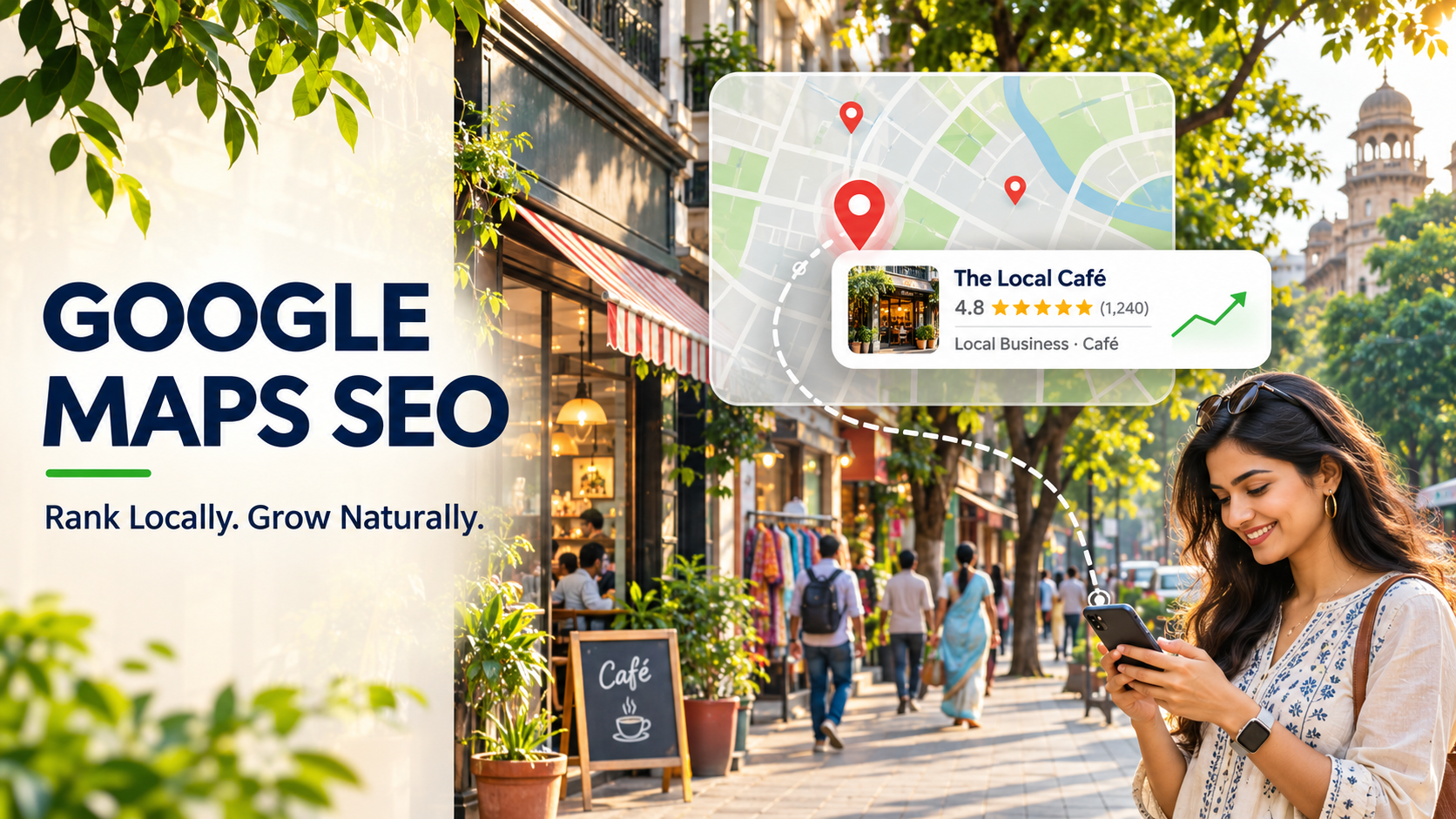
When someone searches for “digital marketing agency near me,” “best dentist in Bhopal,” or “website development company near me,” Google often displays nearby businesses directly on Google Maps.
For local businesses, appearing in these results can create valuable opportunities to attract customers who are actively looking for products or services.
But simply creating a Google Business Profile is not enough.
Your competitors may have stronger profiles, better reviews, more relevant websites, or a more established local online presence.
That is where Google Maps SEO becomes important.
In this guide, we explain how Google Maps ranking works, what matters for local SEO in 2027, and how businesses can improve their visibility to generate more enquiries, calls, and customers.
What Is Google Maps SEO?
Google Maps SEO is the process of improving a business's visibility in local search results on Google Search and Google Maps.
It involves optimizing your Google Business Profile, improving your website's local relevance, maintaining accurate business information, earning genuine reviews, and strengthening your online reputation.
For example, if someone searches for “SEO services in Bhopal,” Google may show a map containing relevant local agencies.
Businesses that appear prominently in those results have an opportunity to receive enquiries without paying for every click.
Google Maps optimization is particularly valuable for:
Digital marketing agencies
Clinics and healthcare providers
Restaurants and cafés
Real estate businesses
Salons and beauty services
Educational institutions
Home service providers
Local retailers
Website and app development companies
The objective is not merely to appear on the map. It is to attract relevant local searches and turn that visibility into meaningful business enquiries.
Why Google Maps SEO Matters in 2027
Local search continues to be an important discovery channel for customers who want nearby services, directions, business hours, reviews, or contact details.
At the same time, AI is becoming more integrated into how businesses manage their digital presence.
In June 2026, Google announced new Gemini features that connect with Google Business Profile, helping business owners analyze profile performance, work with customer reviews, and manage business information.
This reflects a wider movement toward more accessible, AI-assisted business management.
However, there is an important distinction: AI tools can help you manage and understand your business information, but they do not guarantee higher Google Maps rankings.
The fundamentals remain important: accurate information, genuine customer trust, local relevance, and a useful website.
For businesses planning their marketing strategy for 2027, local SEO should be treated as an ongoing customer acquisition channel.
How Does Google Maps Ranking Work?
According to Google's official guidance, local search results are primarily influenced by three factors:
1. Relevance
Relevance describes how closely a business matches what someone is searching for.
Suppose a customer searches for “mobile app development company.”
A business profile that clearly identifies its app development services is easier for Google to match with that search than a vague profile with incomplete service information.
To improve relevance:
Choose the most accurate primary business category.
Add relevant secondary categories where appropriate.
Complete the services section.
Write a clear business description.
Ensure your website explains the services you actually provide.
Avoid adding unrelated categories simply to appear for more searches.
2. Distance
Distance refers to how close a business is to the location associated with a search.
For example, someone searching for a nearby restaurant in Bhopal may see different results from someone searching in Indore.
Distance is not something businesses can freely optimize through keywords.
Your location must accurately represent where your business operates.
Adding fake addresses or creating profiles for locations where you do not genuinely operate can violate Google's policies.
3. Prominence
Prominence refers to how established or well-known a business is.
Google considers signals such as online references, links, reviews, and other information about the business.
Building prominence takes time.
Businesses can strengthen their presence through genuine customer reviews, reputable local mentions, helpful content, and consistent branding across relevant online platforms.
Expert takeaway: Google Maps rankings are not controlled by a single trick. Successful local SEO combines relevance, distance, and prominence with a trustworthy customer experience.
How to Rank Higher on Google Maps in 2027: 10 Practical Strategies
1. Create and Verify Your Google Business Profile
Your Google Business Profile is the foundation of Google Maps SEO.
If your business is eligible, claim or create your profile and complete the verification process requested by Google.
After verification, review all major business details:
Business name
Primary category
Additional relevant categories
Address or service area
Contact information
Website URL
Business hours
Services
Business description
Use the same real-world business name that customers recognize.
For example, a company called “ABC Digital Solutions” should not rename its profile “ABC Digital Solutions Best SEO Agency Bhopal Cheap Web Development” just to target additional keywords.
That approach creates unnecessary policy risk.
2. Select the Right Business Categories
Your primary category should accurately describe your main business activity.
Secondary categories can help describe other legitimate activities, but they should not be used as a list of every keyword you want to rank for.
For a business offering several digital services, category selection should reflect its actual business model.
A clear, accurate category is more useful than numerous loosely related selections.
Review the categories available in Google Business Profile and choose the closest matches.
3. Optimize Your Business Description Naturally
Your Google Business Profile description should explain:
What your business does.
Who it serves.
Which services it provides.
What makes the business useful to customers.
Use local keywords only where they fit naturally.
Example business description:
“ABC Digital Solutions provides website development, SEO, digital marketing, and mobile app development services for businesses in Bhopal. Our team helps startups and established companies strengthen their online presence, improve customer engagement, and build effective digital solutions.”
This is more useful than repeatedly inserting phrases such as “best SEO company,” “top SEO agency,” and “No. 1 digital marketing services.”
The goal is clarity and relevance, not keyword repetition.
4. Build a Local SEO-Friendly Website
A Google Business Profile and a business website should work together.
Your website gives customers the information they need before making an enquiry.
A strong local business website should have:
A clear homepage explaining your services.
Dedicated pages for important services.
Accurate business contact details.
Easy navigation on mobile devices.
Fast, reliable loading.
Genuine testimonials or project examples.
Location-specific information where relevant.
Clear calls to action.
For instance, a digital marketing company can create dedicated pages for SEO, Google Ads, website development, and lead generation.
Instead of forcing every service onto one page, dedicated content can answer each customer's questions more effectively.
Businesses that need an effective website can explore professional web development services from iNext ETS.
5. Create Helpful Location-Specific Content
Local landing pages can be valuable when they provide genuinely different information for the locations a business serves.
For example:
Website development services in Bhopal
SEO services for local businesses in Indore
Digital marketing services for businesses in Madhya Pradesh
However, creating dozens of nearly identical pages with only the city name changed is unlikely to provide a good user experience.
Each location page should have a legitimate purpose.
Where applicable, include:
Services actually available in that location
Local project examples
Relevant customer needs
Genuine testimonials
Service area details
Clear enquiry options
A useful location page should help a potential customer decide whether your business is the right choice.
6. Encourage Genuine Customer Reviews
Reviews help potential customers evaluate a business before calling, visiting, or purchasing.
They can also contribute to a business's local prominence.
A practical review strategy includes asking customers for honest feedback after a real interaction.
You can request reviews through an appropriate follow-up message or share your official Google review link.
Never:
Purchase fake reviews.
Offer discounts or gifts in exchange for positive ratings.
Ask employees to pose as customers.
Pressure customers to change negative reviews.
Post misleading reviews about competitors.
Google prohibits fake and incentivized engagement, and violations can lead to review removal or Business Profile restrictions.
Expert tip: Focus on authentic customer experience. A detailed review that accurately describes a service can be useful to future customers.
7. Respond Professionally to Customer Reviews
Review management is not only about collecting ratings.
It is also an opportunity to demonstrate accountability and customer care.
For a positive review, acknowledge the customer's experience without excessive promotion.
Example:
“Thank you for sharing your experience with our website development team. We're glad the project met your expectations and appreciate your trust.”
For a negative review, respond calmly and offer an appropriate way to resolve the concern.
Avoid sharing private customer information in public responses.
Professional responses help potential customers understand how your business handles feedback.
8. Add Authentic Photos and Videos
Images help customers evaluate what a business offers.
Depending on the business, useful visuals may include:
Real office or storefront photos
Team photographs
Products
Completed projects
Business facilities
Service demonstrations
Behind-the-scenes content
For a digital marketing agency, authentic team photographs, workspace images, and project-related visuals may be more convincing than generic stock images.
Keep your images relevant and accurate.
Google Business Profile photos are an opportunity to represent your business, not a guaranteed ranking shortcut.
9. Build Local Citations and Relevant Links
A local citation is a mention of your business information on another website or directory.
Examples include relevant business directories, professional associations, industry websites, and trusted local publications.
Consistency matters.
Your business name, address where applicable, and contact details should not contradict each other across major platforms.
For instance, if your actual business name is “ABC Digital Solutions,” avoid using multiple invented names across directories.
Relevant backlinks can also strengthen your wider online presence.
Focus on legitimate opportunities such as:
Local business associations
Industry partnerships
Community initiatives
Relevant editorial coverage
Professional directories
Genuine business collaborations
Avoid buying large batches of low-quality directory links or publishing repetitive content solely to manipulate rankings.
A sustainable SEO strategy should strengthen the business's credibility as well as its search visibility.
10. Track Calls, Enquiries, and Actual Customers
Ranking higher is valuable only when it contributes to a useful business outcome.
Instead of tracking Google Maps positions alone, monitor:
Business Profile interactions
Website visits from your profile
Phone call activity
Direction requests, where relevant
Form enquiries
Qualified leads
Booked appointments
Sales or completed projects
Use appropriate UTM parameters on your Business Profile website link so you can identify relevant website sessions in Google Analytics.
Connect website forms and other enquiry channels to reliable conversion measurement.
For businesses running multiple marketing channels, it is important to understand whether enquiries originate from Google Maps, organic search, paid advertising, or another source.
Learn how a structured lead generation strategy can connect website traffic with meaningful customer enquiries.
Google Maps SEO vs Traditional SEO: What's the Difference?
Both help improve online discoverability, but they focus on different types of search results.
| Google Maps SEO | Traditional SEO |
|---|---|
| Focuses on local visibility | Focuses on broader organic search visibility |
| Uses Google Business Profile | Primarily optimizes website content and technical elements |
| Strongly influenced by relevance, distance, and prominence | Influenced by many website and search-quality signals |
| Often targets local service searches | Can target local, national, or international searches |
| Common outcomes include calls, directions, and local enquiries | Outcomes include organic traffic, leads, and conversions |
Businesses frequently benefit from both approaches.
For example, a user might discover a company through Google Maps, visit its website to compare services, and then submit a contact form.
That journey connects local SEO with website optimization and conversion-focused marketing.
Does AI Change Google Maps SEO in 2027?
AI is influencing how business owners manage information and how users discover businesses.
Google's 2026 announcement about Gemini and Google Business Profile introduced capabilities designed to help business owners work with profile insights, reviews, and updates.
That does not mean a business can simply activate AI features and expect higher Maps rankings.
The practical opportunity is to maintain reliable business information and provide helpful content that both customers and search systems can understand.
Businesses should prioritize:
Accurate business details
Clearly explained services
Useful website content
Genuine reviews
Updated operating information
Trustworthy business information
Strong mobile user experience
For businesses exploring broader AI visibility, our guide to AI SEO in 2027 explains how search discovery is evolving across AI-powered platforms.
Common Google Maps SEO Mistakes to Avoid
Keyword Stuffing in Your Business Name
Adding unnecessary service or location keywords to the registered business name can violate Google's guidelines.
Use your genuine business name.
Creating Fake Business Locations
Virtual offices and fabricated local addresses are not acceptable substitutes for real eligible business locations.
A service-area business should configure its profile according to Google's rules.
Ignoring Negative Reviews
Unanswered concerns may discourage potential customers.
Respond thoughtfully and resolve genuine issues where possible.
Publishing Duplicate Location Pages
Pages that repeat almost identical content for different cities are unlikely to provide meaningful value.
Build location pages around real services and unique local information.
Expecting Guaranteed Rankings
No agency can guarantee the number-one Google Maps position for every user.
Local results vary based on the search, location, relevance, and other signals.
Measuring Rankings but Not Leads
A business may gain visibility without improving enquiries if its contact information, service pages, or offers are weak.
Review the entire customer journey.
A Practical 30-Day Google Maps SEO Action Plan
A structured approach makes local SEO easier to manage.
| Timeline | Recommended Actions |
|---|---|
| Week 1 | Audit and verify the Google Business Profile; correct categories, hours, contact details, and service information |
| Week 2 | Improve key website pages, mobile experience, location details, and enquiry forms |
| Week 3 | Request genuine customer feedback, upload authentic visuals, and correct important business citations |
| Week 4 | Review profile performance, test lead tracking, identify content gaps, and plan ongoing improvements |
The first month is about establishing a reliable foundation.
More substantial visibility gains may require continued work over a longer period, depending on the business, location, competition, and starting point.
How Much Does Google Maps SEO Cost in India?
The cost depends on the work required.
A small business with one location and a complete website may need a limited optimization project.
A business with multiple eligible locations, outdated information, technical website issues, and competitive local search results will generally require more extensive work.
The main cost factors include:
Number of business locations
Current Google Business Profile condition
Local competition
Website quality
Content requirements
Citation cleanup
Review management processes
Reporting and analytics setup
Creating a Google Business Profile is free. Businesses may still choose to invest in professional optimization and ongoing local SEO support.
Before hiring an agency, request a clear explanation of the work included, reporting methods, expected deliverables, and how business outcomes will be measured.
Avoid providers that promise guaranteed first-place rankings.
How iNext ETS Can Help Improve Your Local Search Visibility
A strong local SEO strategy connects search visibility with customer acquisition.
At iNext ETS, our digital marketing and website development services can support businesses that want to improve their online presence and generate more relevant enquiries.
Depending on your requirements, this may include:
Local SEO and search visibility assessment
Google Business Profile optimization planning
Website structure and content improvements
Service-page optimization
Conversion-focused website recommendations
Lead tracking and performance measurement
Ongoing digital marketing strategy
Explore our digital marketing services to understand how search, content, and conversion optimization can work together.
Ready to Get More Customers from Google Maps?
If customers are searching for your services but finding your competitors first, it may be time to review your local online presence.
Let iNext ETS help you identify opportunities to improve visibility and turn relevant searches into business enquiries.
Contact iNext ETS for an SEO consultation
Conclusion
Google Maps SEO in 2027 is about making your business easier to discover, understand, and trust.
Complete and accurate business information, a helpful website, genuine customer reviews, and consistent local marketing can all support a stronger presence in local search.
The most effective approach goes beyond chasing rankings.
It connects Google Maps visibility with a website that answers customer questions, reliable enquiry tracking, and a clear process for converting prospects into customers.
For businesses ready to strengthen their local digital presence, iNext ETS offers digital marketing and development services that can support that growth.